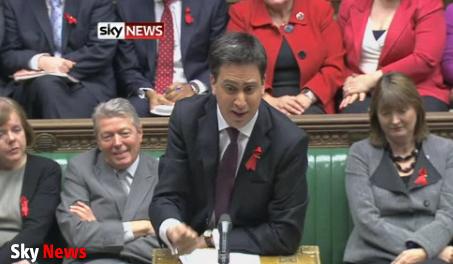
Well, today's session was certainly different: It was the most civilised PMQs I have ever seen. If I was being cruel, I might say that Ed Miliband has given up trying to better David Cameron, but I don't think that's the case. Of course he's not been particularly effective recently, but I think what his new approach signifies is a new approach from the Labour leader to his role.
Now that he has the economic terrier Ed Balls in the Shadow Chancellor's role and has Doug Alexander as his hyperactive media spokesman, Ed Miliband does not need to get his hands dirty fighting David Cameron. I have long been critical of Miliband's poor debating style and it seems he's found a way to overcome it, because this new approach meant that it was totally irrelevant. He's changed the game in a manner I frankly did not expect, and deserves full credit for it.
I'm not suggesting that every PMQs will be like this - today's topics of Afghanistan and Egypt are two areas where the Government and Opposition are largely in agreement - but that the shift in style is an acknowledgement that what Miliband was doing wasn't working, and that it was actually harming his image. What we saw today was an attempt to rise above the usual 'bunfight' that is PMQs and begin the era of 'new politics', which is still an often repeated but largely meaningless phrase. If Ed Miliband can create that kind of pure political image he'll be in a very strong position - although he may well find that David Cameron can play this game too.
So how on earth do you score this, given that they didn't really compete and they agreed on pretty much every point? What I think has to be noted is that this style of PMQs stemmed from a change in approach by Ed Miliband. Because of the nature of PMQs, the Prime Minister doesn't really have a chance to set the initial tone. So for creating a novel atmosphere and changing a dynamic that has not suited him, the win must go to Ed Miliband.
Remarkable Ed Miliband victory.
Showing posts with label David Cameron. Show all posts
Wednesday, 2 February 2011
Sunday, 30 January 2011
Weekly Round-up - 30.01.11
This week was dominated by figures released on Tuesday which showed that the UK economy had shrunk by 0.5% in the final quarter of 2010. Most economists had predicted 0.5% growth. Combined with December's inflation figure of 3.7% - way above the Bank of England's 2% target - and Mervyn King's warning that inflation could top 5% in 2011, it was a bad week for George Osborne. The figures were a gift to Labour but Ed Miliband failed to make the most of them at PMQs on Wednesday, as Cameron put in one of his best, and most statesmanlike performances.
The other big news this week was the belated publication of the Government's review into the UK's counter-terrorism measures. There was some good news - a reduction in the duration of detention without charge from 28 days to 14 days, curbs on police stop and search powers and measures to stop local councils using surveillance operations so much - and the review was definitely a success for Nick Clegg and the liberal wing of the Tories, but it did not go as far as some would have liked. Control Orders were replaced with TPIMs (Terrorism Prevention and Investigation Measures) but contain many of the same provisions, even if they are a little less stringent. The problem of dealing with these suspects outside the criminal justice system still exists though.
Elsewhere, Lord Lawson and Mark Pritchard helpfully stuck it to David Cameron by kicking up a fuss about the undesirability of coalition government. We also saw the MoD scrambling to defend itself against allegations from senior military figures that they were leaving a huge hole in Britain's defence capabilities by scrapping nine new Nimrod aircraft. And we were treated to more Eurozone grumblings as Germany continued to push for stringent budget checks across Europe rather than immediately back Commission President Jose Manuel Barosso's bail-out fund.
The other big news this week was the belated publication of the Government's review into the UK's counter-terrorism measures. There was some good news - a reduction in the duration of detention without charge from 28 days to 14 days, curbs on police stop and search powers and measures to stop local councils using surveillance operations so much - and the review was definitely a success for Nick Clegg and the liberal wing of the Tories, but it did not go as far as some would have liked. Control Orders were replaced with TPIMs (Terrorism Prevention and Investigation Measures) but contain many of the same provisions, even if they are a little less stringent. The problem of dealing with these suspects outside the criminal justice system still exists though.
Elsewhere, Lord Lawson and Mark Pritchard helpfully stuck it to David Cameron by kicking up a fuss about the undesirability of coalition government. We also saw the MoD scrambling to defend itself against allegations from senior military figures that they were leaving a huge hole in Britain's defence capabilities by scrapping nine new Nimrod aircraft. And we were treated to more Eurozone grumblings as Germany continued to push for stringent budget checks across Europe rather than immediately back Commission President Jose Manuel Barosso's bail-out fund.
Labels:
David Cameron,
Defence,
Economy,
Ed Miliband,
EU,
GDP,
Inflation,
Jose Manuel Barroso,
Lord Lawson,
Mervyn King
Wednesday, 26 January 2011
PMQs Review - 26th January 2011
My prediction that the economic figures released yesterday would dominate PMQs was borne out as Ed Miliband made the UK's 0.5% contraction the focus for has six questions. The problem was that he faced the most agile David Cameron I've seen at the dispatch box in weeks and that he was relentlessly barracked by the Government benches.
Miliband got a cheer when he rose - reflecting new found belief on the Labour benches - but his first question was predictable and weak. He asked, in the deadpan way that he always does with his first question, what the cause of the poor economic performance was: Cue dozens of Tories and Lib Dems shouting 'YOU!' at the Labour leader.
Cameron's approach clearly confused Miliband. He stepped up and said the figures were 'disappointing' even without the impact of snow. Cameron taking responsibility and bringing up the bad weather first was clearly not something that Miliband was prepared for, and it exposed Miliband's inability to adapt. He asked Cameron if without the weather growth would have been flat. Cameron simply said 'yes'.
The next exchange began with Miliband's best line of the day, when he shot back at Cameron that the PM didn't understand that without growth there would be no recovery. But he was clearly rattled and the Tory backbenches began to mercilessly mock his stuttering style of delivery. Cameron responded by quoting the head of the OECD, who had said that before the Coalition's deficit reduction plan the economy had been 'out of control'.
The following question was another example of Miliband's apparent inability to 'war game' PMQs properly. If he'd been through a preparatory dual with an aide then he would have rapidly realised that claiming that the Labour Party left a legacy of growth was a poor strategy. Cameron jumped on the 'laughable proposition' that Labour left a 'golden legacy' and reeled off a list of Labour's economic failures.
Miliband was beaten. Lost. He didn't seem to know what he was going to ask so just made some comment about Cameron being out of touch. The Tories laughed at him. Miliband went personal and attacked Cameron's 'arrogance'. Cameron made a joke - which to be frank he's already used too much in the House - about Miliband's inability to think on his feet before highlighting Labour's own deficit reduction plans, which were due to start this year.
Miliband recovered with his last question. He launched into an attack on Andy Coulson, which wasn't particularly coherent but did raise an important point. He also raised the comments by David Davis, who said that without the former NotW man Cameron's inner circle was out of touch. Unfortunately he then said the Coalition's policies were 'hurting not working'. It didn't even rhyme properly. Cameron finished him off by asking why he was claiming credit for appointing Ed Balls when he didn;t want him in the first place and by outlining the coalition's plan to deal with the deficit to ensure growth.
I said yesterday that Miliband would have no excuses for not winning today. In fairness to him, Cameron's strategy was proactive and he gave his best ever performance against the new Labour leader. But so many of Cameron's lines were easily prepared put-downs to predictable questions. And too often when put on the spot Miliband simply failed to think quickly and adapt. He almost always starts with a simple factual question, before asking a couple more and then getting confused when the course of the debate takes a different route to the one he'd prepared. With better preparation he could be so much more effective.
Solid Cameron win.
Miliband got a cheer when he rose - reflecting new found belief on the Labour benches - but his first question was predictable and weak. He asked, in the deadpan way that he always does with his first question, what the cause of the poor economic performance was: Cue dozens of Tories and Lib Dems shouting 'YOU!' at the Labour leader.
Cameron's approach clearly confused Miliband. He stepped up and said the figures were 'disappointing' even without the impact of snow. Cameron taking responsibility and bringing up the bad weather first was clearly not something that Miliband was prepared for, and it exposed Miliband's inability to adapt. He asked Cameron if without the weather growth would have been flat. Cameron simply said 'yes'.
The next exchange began with Miliband's best line of the day, when he shot back at Cameron that the PM didn't understand that without growth there would be no recovery. But he was clearly rattled and the Tory backbenches began to mercilessly mock his stuttering style of delivery. Cameron responded by quoting the head of the OECD, who had said that before the Coalition's deficit reduction plan the economy had been 'out of control'.
The following question was another example of Miliband's apparent inability to 'war game' PMQs properly. If he'd been through a preparatory dual with an aide then he would have rapidly realised that claiming that the Labour Party left a legacy of growth was a poor strategy. Cameron jumped on the 'laughable proposition' that Labour left a 'golden legacy' and reeled off a list of Labour's economic failures.
Miliband was beaten. Lost. He didn't seem to know what he was going to ask so just made some comment about Cameron being out of touch. The Tories laughed at him. Miliband went personal and attacked Cameron's 'arrogance'. Cameron made a joke - which to be frank he's already used too much in the House - about Miliband's inability to think on his feet before highlighting Labour's own deficit reduction plans, which were due to start this year.
Miliband recovered with his last question. He launched into an attack on Andy Coulson, which wasn't particularly coherent but did raise an important point. He also raised the comments by David Davis, who said that without the former NotW man Cameron's inner circle was out of touch. Unfortunately he then said the Coalition's policies were 'hurting not working'. It didn't even rhyme properly. Cameron finished him off by asking why he was claiming credit for appointing Ed Balls when he didn;t want him in the first place and by outlining the coalition's plan to deal with the deficit to ensure growth.
I said yesterday that Miliband would have no excuses for not winning today. In fairness to him, Cameron's strategy was proactive and he gave his best ever performance against the new Labour leader. But so many of Cameron's lines were easily prepared put-downs to predictable questions. And too often when put on the spot Miliband simply failed to think quickly and adapt. He almost always starts with a simple factual question, before asking a couple more and then getting confused when the course of the debate takes a different route to the one he'd prepared. With better preparation he could be so much more effective.
Solid Cameron win.
Labels:
David Cameron,
Economy,
Ed Miliband,
GDP,
PMQs,
Tories
Tuesday, 25 January 2011
PMQs Preview - 26th January 2011
This is not going to be a long post. In fact I wrote that sentence just to beef it up a bit. Because PMQs tomorrow is only going to be about one thing: today's shock 0.5% GDP contraction. Balls has already launched a pretty effective broadside on Osborne tonight, claiming that the 0.7% GDP growth in the previous quarter was a legacy of Labour's spending plans and that these are the first set of figures that reflect the Conservatives' economic policies.
Surely even Ed Miliband can make this stick tomorrow. For all their bluster Cameron and Osborne know that the weather did not cause all this damage alone - and that blaming the snow is a line that won't play well in the House. Expect their VAT hike to take a beating. Despite this, Balls' record under Brown and the resignation of Alan Johnson late last week should give Cameron something to hold on to, even if Miliband can just point to Coulson and previous Tory calls for more financial deregulation. It should be fun...
Labels:
Alan Johnson,
Andy Coulson,
David Cameron,
Ed Balls,
Ed Miliband,
GDP,
George Osborne,
ONS,
PMQs
Monday, 24 January 2011
YouGov polls don't look too bad for the coalition
Just a quick post to highlight a few statistics from this weekend's YouGov poll. First up, we have the results of a question asking how well certain politicians are doing, which gives Cameron an approval rating of -6%, puts Miliband on -11%, and Clegg on -34%. The discrepancy with the overall voting intention is obvious: Labour are ahead on 43%, followed by the Tories on 39% and the Lib Dems on 9%. It seems that despite a steady decline since May, Cameron is still the Conservative's best electoral asset and Miliband is still failing to impress the public.
Despite Cameron's personal popularity, the Government's approval rating has fallen to -22%. But this figure won't upset the coalition too much, given that they believe that by 2013 there will be a resurgent economy and that they'll get all the credit. Based on this, the -28% rating for Miliband's ability to handle the economy, and the fact that all anyone in politics has talked about for the past two years has been recession and debt, I think the coalition will feel that if they stay committed to their deficit reduction programme they'll come out the other end in a very strong position indeed.
Labels:
David Cameron,
Economy,
Ed Miliband,
Nick Clegg,
Polling,
YouGov
Sunday, 23 January 2011
Weekly Round-up - 23.01.11
This week will certainly be remembered for the two dramatic resignations that came on Thursday and Friday. Alan Johnson's decision to resign, taken late Thursday afternoon, was a shock because despite his rather embarrassing inability to master his economic brief he still retained the confidence of Ed Miliband. His decision to leave for personal reasons - it appears his wife is filing for divorce -will mean that the attacks on Miliband's personal judgement which will inevitably come next week will not be as effective. But the Labour leader will still have to answer some awkward questions now that Ed Balls, the man that he deliberately snubbed last year, is his new Shadow Chancellor.
We were also treated, early on Friday morning, to the resignation of Andy Coulson, David Cameron's Director of Communications. This was not a total surprise - it had been a question of when not if - but the timing was a little unexpected. The case against Coulson personally has a lot of circumstantial evidence but has so far lacked concrete proof. He had quite accurately realised that he had committed the cardinal sin for a press officer and become the story, but that had been true to some extent since he was hired. While it was excruciating to see an opportunistic Ed Miliband question Cameron's judgement just hours after his own inept Shadow Chancellor had walked, the PM will quite rightly face some hard questions next week about his decision to hire the former NotW Editor. As a final point, it is worth noting that without question both Johnson and Coulson chose to use the appearance of Tony Blair at the Chilcot inquiry as cover for their resignations.
The rest of the week was dominated by unemployment figures that made particularly depressing reading for young people, and the official launch of Andrew Lansley's NHS reforms, which - although well-intentioned and if successful will radically improve the way the NHS operates - represent an unusual gamble by the PM.
We were also treated, early on Friday morning, to the resignation of Andy Coulson, David Cameron's Director of Communications. This was not a total surprise - it had been a question of when not if - but the timing was a little unexpected. The case against Coulson personally has a lot of circumstantial evidence but has so far lacked concrete proof. He had quite accurately realised that he had committed the cardinal sin for a press officer and become the story, but that had been true to some extent since he was hired. While it was excruciating to see an opportunistic Ed Miliband question Cameron's judgement just hours after his own inept Shadow Chancellor had walked, the PM will quite rightly face some hard questions next week about his decision to hire the former NotW Editor. As a final point, it is worth noting that without question both Johnson and Coulson chose to use the appearance of Tony Blair at the Chilcot inquiry as cover for their resignations.
The rest of the week was dominated by unemployment figures that made particularly depressing reading for young people, and the official launch of Andrew Lansley's NHS reforms, which - although well-intentioned and if successful will radically improve the way the NHS operates - represent an unusual gamble by the PM.
Labels:
Alan Johnson,
Andrew Lansley,
Andy Coulson,
David Cameron,
Ed Balls,
Ed Miliband,
NHS
Wednesday, 19 January 2011
PMQs Review - 19th January 2011
Bit of an odd session today, with a six-question break in the middle of Ed Miliband's questions to the PM. Even odder, however, was the huge cheer that Miliband got when he stood up to speak: for a split-second I think he thought something else was going on in the Chamber. Still, it's definitely good news for the Labour leader that his party is starting to support him.
The first question, as it tends to be with Miliband, was very simple. He asked if it was a good thing that unemployment was rising. Cameron responded very well and actually gave an honest answer, stating that he was worried about the figures but that there was some progress being made. He then, cleverly, raised the issue of youth unemployment and pre-empted the Leader of the Opposition by saying that it had increased by 40% under Labour.
And so it all started to go wrong for Ed. He clumsily read out his clearly scripted line which bore no relation to what Cameron had just said, and accused him of being complacent - Cameron's answer had been anything but. He then delivered a hopeless line about how the PM was 'rumbled' in Oldham. It made no sense. Predictably, Cameron laid into him for his inability to debate properly and his reliance on his notes, before easily swatting away his attack on the coalition's decision to scrap the Future Jobs Fund with some excellent statistics.
We then endured a 6-question interlude before Miliband got back up to ask the PM if he could guarantee that hospital waiting times would not increase. This was a well-designed question, because the PM can't guarantee it. He can't because he's abolished top-down targets, and that means that there is no longer scope for a centrally imposed guarantee. But Cameron failed to make this point, and to argue that his reforms would reduce waiting times, which was his biggest slip-up of the day. Instead he just started to attack Labour for not promising an increase in NHS spending.
Miliband then pushed him on the same point again, and made a very good point about NHS waiting times going down under Labour. Cameron made the same response as before, criticising the Labour Party for not promising to increase NHS spending and trying - pretty unsuccessfully - to paint the Conservatives as the party of the NHS.
Miliband said Cameron was taking the 'National out of the NHS', which is a nice line but didn't really reinforce the point Miliband made in the previous question. Miliband then got a little personal, and called the PM 'arrogant'. By now Cameron had got back into his swing, and he came up with a line - I've no idea why he didn't use it earlier - that the waiting list times were in the NHS constitution. He also said the reforms would save £5bn and improve the NHS.
The session started with Cameron on top and ended the same way too. Miliband made some comments about broken promises which didn't fit his earlier questions and were horrendously delivered, prompting Cameron to make yet another joke about his sub-standard debating skills.
What's most worrying for Miliband is that if he can't kick Cameron around on Lansley's NHS reforms and bankers' bonuses then what can he beat him on? These were golden opportunities for Miliband to make life very hard for Cameron and yet, aside from a couple of good questions, he has not managed to do it. So poor is his delivery and his inability to divert from his script that he's managed to make it an issue that Cameron highlights as much as Miliband picks up on dodged questions. Cameron was on better form than last week and, aside from one missed opportunity, was on top for the whole debate. So while Miliband's attacks on the NHS might play well in public, they were not good enough to save him from defeat today.
Cameron win.
The first question, as it tends to be with Miliband, was very simple. He asked if it was a good thing that unemployment was rising. Cameron responded very well and actually gave an honest answer, stating that he was worried about the figures but that there was some progress being made. He then, cleverly, raised the issue of youth unemployment and pre-empted the Leader of the Opposition by saying that it had increased by 40% under Labour.
And so it all started to go wrong for Ed. He clumsily read out his clearly scripted line which bore no relation to what Cameron had just said, and accused him of being complacent - Cameron's answer had been anything but. He then delivered a hopeless line about how the PM was 'rumbled' in Oldham. It made no sense. Predictably, Cameron laid into him for his inability to debate properly and his reliance on his notes, before easily swatting away his attack on the coalition's decision to scrap the Future Jobs Fund with some excellent statistics.
We then endured a 6-question interlude before Miliband got back up to ask the PM if he could guarantee that hospital waiting times would not increase. This was a well-designed question, because the PM can't guarantee it. He can't because he's abolished top-down targets, and that means that there is no longer scope for a centrally imposed guarantee. But Cameron failed to make this point, and to argue that his reforms would reduce waiting times, which was his biggest slip-up of the day. Instead he just started to attack Labour for not promising an increase in NHS spending.
Miliband then pushed him on the same point again, and made a very good point about NHS waiting times going down under Labour. Cameron made the same response as before, criticising the Labour Party for not promising to increase NHS spending and trying - pretty unsuccessfully - to paint the Conservatives as the party of the NHS.
Miliband said Cameron was taking the 'National out of the NHS', which is a nice line but didn't really reinforce the point Miliband made in the previous question. Miliband then got a little personal, and called the PM 'arrogant'. By now Cameron had got back into his swing, and he came up with a line - I've no idea why he didn't use it earlier - that the waiting list times were in the NHS constitution. He also said the reforms would save £5bn and improve the NHS.
The session started with Cameron on top and ended the same way too. Miliband made some comments about broken promises which didn't fit his earlier questions and were horrendously delivered, prompting Cameron to make yet another joke about his sub-standard debating skills.
What's most worrying for Miliband is that if he can't kick Cameron around on Lansley's NHS reforms and bankers' bonuses then what can he beat him on? These were golden opportunities for Miliband to make life very hard for Cameron and yet, aside from a couple of good questions, he has not managed to do it. So poor is his delivery and his inability to divert from his script that he's managed to make it an issue that Cameron highlights as much as Miliband picks up on dodged questions. Cameron was on better form than last week and, aside from one missed opportunity, was on top for the whole debate. So while Miliband's attacks on the NHS might play well in public, they were not good enough to save him from defeat today.
Cameron win.
Labels:
David Cameron,
Ed Miliband,
NHS,
PMQs,
Unemployment
Sunday, 16 January 2011
Weekly Round-up - 16-01-11
Westminster politics got underway again this week and provided us with plenty of action to kick-off 2011. The week’s most amusing story was the news that Tory MP Mark Pritchard, who is Deputy Chairman of the 1922 Committee, got into an altercation with John Bercow and ended up shouting ‘You are not fucking royalty’ at the Speaker before storming off. It’s another indication of just how much the Speaker has fallen out with his former party.
The big news of the week was, of course, the result of the Oldham East and Saddleworth by-election. Yet as exciting as it was, it didn’t really change anything. Labour, and particularly Ed Miliband, needed a comfortable win: they got it. The Lib Dems needed to show that their support had not totally collapsed and that they could still compete: they did that. The Tory high command just needed the Lib Dems to survive in order to ensure the stability of the coalition: which is exactly what happened. No party will be particularly unhappy with this result.
The story that dominated the first half of the week was bankers’ bonuses. This came to its head on Wednesday with a very competitive PMQs after Chancellor George Osborne had been called to the House for emergency questions on Tuesday. Ed Miliband – who has had a pretty good week for once – embarrassed the PM by pointing out that the Tories’ website still proudly displayed his election pledge to limit bankers’ bonuses to £2,000. Yet despite early hits, Miliband is still a PMQs’ amateur and, unwilling to depart from his prepared script, failed to kill off Cameron and let him back in to steal a draw.
The Government also managed to overcome some backbench resistance to defeat an amendment to its EU Sovereignty Bill, but left itself in an unhappy position by proposing a piece of legislation which is detested by the very people it was designed to appease. We also found out that the decision on Control Orders is to be delayed until next week because of ongoing cabinet disputes.
YouGov also released figures this week that placed The Conservatives on 36%, 7% behind Labour on 43%. While they may be an anomaly, these figures did reinforce recent ComRes figures that showed Labour with an 8% lead. Interestingly, while Labour support has risen since May it is steady around 42%, and these big leads are occurring because of a fall in Conservative support.
The big news for the economy this week came from the MPC, which decided to keep interest rates at 0.5%. It hopes that this will create the right environment for economic growth, and is choosing to focus on this rather than efforts to rein in inflation. There was also some good news from credit rating agency Moody’s, which said that the UK’s AAA rating was safe.
In Europe the EU’s High Representative for Foreign Affairs, Baroness Ashton, suggested that the arms embargo to China should be lifted for the good of the European economy. This came after a visit by Chinese Vice-Premier – and probable future PM – Li Keqiang to various European capitals. Given the shock that reverberated around Western defence circles after new stealth fighter technology was unveiled just before US Defense Secretary Robert Gates’ trip to China, it is highly unlikely that the US and UK would be keen on such a move.
YouGov Polling 13-01-11
Conservative 41%
Labour 41%
Liberal Democrat 8%
Government Approval -17%
The big news of the week was, of course, the result of the Oldham East and Saddleworth by-election. Yet as exciting as it was, it didn’t really change anything. Labour, and particularly Ed Miliband, needed a comfortable win: they got it. The Lib Dems needed to show that their support had not totally collapsed and that they could still compete: they did that. The Tory high command just needed the Lib Dems to survive in order to ensure the stability of the coalition: which is exactly what happened. No party will be particularly unhappy with this result.
The story that dominated the first half of the week was bankers’ bonuses. This came to its head on Wednesday with a very competitive PMQs after Chancellor George Osborne had been called to the House for emergency questions on Tuesday. Ed Miliband – who has had a pretty good week for once – embarrassed the PM by pointing out that the Tories’ website still proudly displayed his election pledge to limit bankers’ bonuses to £2,000. Yet despite early hits, Miliband is still a PMQs’ amateur and, unwilling to depart from his prepared script, failed to kill off Cameron and let him back in to steal a draw.
The Government also managed to overcome some backbench resistance to defeat an amendment to its EU Sovereignty Bill, but left itself in an unhappy position by proposing a piece of legislation which is detested by the very people it was designed to appease. We also found out that the decision on Control Orders is to be delayed until next week because of ongoing cabinet disputes.
YouGov also released figures this week that placed The Conservatives on 36%, 7% behind Labour on 43%. While they may be an anomaly, these figures did reinforce recent ComRes figures that showed Labour with an 8% lead. Interestingly, while Labour support has risen since May it is steady around 42%, and these big leads are occurring because of a fall in Conservative support.
The big news for the economy this week came from the MPC, which decided to keep interest rates at 0.5%. It hopes that this will create the right environment for economic growth, and is choosing to focus on this rather than efforts to rein in inflation. There was also some good news from credit rating agency Moody’s, which said that the UK’s AAA rating was safe.
In Europe the EU’s High Representative for Foreign Affairs, Baroness Ashton, suggested that the arms embargo to China should be lifted for the good of the European economy. This came after a visit by Chinese Vice-Premier – and probable future PM – Li Keqiang to various European capitals. Given the shock that reverberated around Western defence circles after new stealth fighter technology was unveiled just before US Defense Secretary Robert Gates’ trip to China, it is highly unlikely that the US and UK would be keen on such a move.
YouGov Polling 13-01-11
Conservative 41%
Labour 41%
Liberal Democrat 8%
Government Approval -17%
Wednesday, 12 January 2011
PMQs Review - 12th Jan 2011
As I predicted, bankers' bonuses dominated PMQs today. What I didn't expect was that Ed Miliband would actually manage to make some of his attacks stick. His first question was his best, pointing out that the Conservatives still had their election pledge to cap bonuses at £2,000 on their website and that Cameron had spectacularly failed to implement it. (Someone at CCHQ should get an earful for this, given that it was raised during the emergency questions to Osborne yesterday.)
Cameron's reply was weak on substance but high on flair, setting the tone for a very personal PMQs. Miliband probably could have pushed on with this line of questioning but he is still too unsure of himself to deviate from what was pretty defined series of questions. Even so, his next question was good, asking Cameron about the amount of money that his Bankers' Levy would raise, and comparing that figure to Labour’s Bankers' Bonus tax.
The PM gave a very long, technical answer to this question which seemed to flummox Miliband. This was a real shame, because Cameron was being a little creative with the facts. He argued that his Levy would raise £2.5bn this year, more than the £2.3bn Labour's tax generated. Miliband argued that Cameron's Levy would raise £1.3bn, and said Labour's Bonus Tax raised 3.5bn.
It was Miliband who had his facts straight. The crafty maths that the Treasury used to get the £3.5bn down to £2.5bn – by making guesses about how much NI and income tax they'd lost in lieu – and the fudged statistic that the Levy would raise £2.5bn – it will in 2012, but not in 2011 – were frankly embarrassing. But fortunately for the PM, it was here that Miliband really let himself down. He stuck to his script again and failed to make it clear just how wrong Cameron was. This was a huge opportunity missed.
He ended up asking a lengthy question demanding more transparency, which gave Cameron the opportunity to turn to Labour's record in Government, and there was little substance to the rest of the session. Cameron scored an easy hit by reminding the House that Miliband had been at the Treasury during Labour's period in power and, in particular, when they had awarded Sir Fred Goodwin a knighthood.
Throughout PMQs it was Cameron who landed the better jokes. The best was an excellent quip that Labour had 'a shadow chancellor who can’t count and a Labour leader who doesn’t count'. He also made frequent references to Johnson’s mathematical shortcomings and claimed 'there’s no point Wallace [Miliband] asking Gromit [Johnson] about that one'. He also suggested that Ed Miliband should switch with his brother: that he should go on TV and let David run the Party.
Yet at times the whole thing threatened to get a bit too personal Cameron said of Miliband that: 'He was the nothing man when he was at the Treasury and he is the nothing man now he's trying to run the Labour Party.' For his part, Miliband commented that Osborne was a 'poisonous fungus'. Cameron tends to get personal when he's in a tight spot, and Miliband was just responding in kind – but it didn't look great for either man.
Bankers' bonuses worked for Miliband today not because he got the best of Cameron but because he pushed an argument that will resonate with the electorate. Miliband had a big opportunity to really punish the PM but he still lacks the confidence to deviate from his script and so Cameron was able to fudge his response, make a few jokes and stop Ed Miliband from winning it, but he was never on strong ground. A good defence by Cameron and a promising start to the year by Ed Miliband.
A very entertaining score draw.
Cameron's reply was weak on substance but high on flair, setting the tone for a very personal PMQs. Miliband probably could have pushed on with this line of questioning but he is still too unsure of himself to deviate from what was pretty defined series of questions. Even so, his next question was good, asking Cameron about the amount of money that his Bankers' Levy would raise, and comparing that figure to Labour’s Bankers' Bonus tax.
The PM gave a very long, technical answer to this question which seemed to flummox Miliband. This was a real shame, because Cameron was being a little creative with the facts. He argued that his Levy would raise £2.5bn this year, more than the £2.3bn Labour's tax generated. Miliband argued that Cameron's Levy would raise £1.3bn, and said Labour's Bonus Tax raised 3.5bn.
It was Miliband who had his facts straight. The crafty maths that the Treasury used to get the £3.5bn down to £2.5bn – by making guesses about how much NI and income tax they'd lost in lieu – and the fudged statistic that the Levy would raise £2.5bn – it will in 2012, but not in 2011 – were frankly embarrassing. But fortunately for the PM, it was here that Miliband really let himself down. He stuck to his script again and failed to make it clear just how wrong Cameron was. This was a huge opportunity missed.
He ended up asking a lengthy question demanding more transparency, which gave Cameron the opportunity to turn to Labour's record in Government, and there was little substance to the rest of the session. Cameron scored an easy hit by reminding the House that Miliband had been at the Treasury during Labour's period in power and, in particular, when they had awarded Sir Fred Goodwin a knighthood.
Throughout PMQs it was Cameron who landed the better jokes. The best was an excellent quip that Labour had 'a shadow chancellor who can’t count and a Labour leader who doesn’t count'. He also made frequent references to Johnson’s mathematical shortcomings and claimed 'there’s no point Wallace [Miliband] asking Gromit [Johnson] about that one'. He also suggested that Ed Miliband should switch with his brother: that he should go on TV and let David run the Party.
Yet at times the whole thing threatened to get a bit too personal Cameron said of Miliband that: 'He was the nothing man when he was at the Treasury and he is the nothing man now he's trying to run the Labour Party.' For his part, Miliband commented that Osborne was a 'poisonous fungus'. Cameron tends to get personal when he's in a tight spot, and Miliband was just responding in kind – but it didn't look great for either man.
Bankers' bonuses worked for Miliband today not because he got the best of Cameron but because he pushed an argument that will resonate with the electorate. Miliband had a big opportunity to really punish the PM but he still lacks the confidence to deviate from his script and so Cameron was able to fudge his response, make a few jokes and stop Ed Miliband from winning it, but he was never on strong ground. A good defence by Cameron and a promising start to the year by Ed Miliband.
A very entertaining score draw.
Labels:
Alan Johnson,
Bankers,
David Cameron,
Ed Miliband,
PMQs
Tuesday, 11 January 2011
PMQs Preview - 12th January 2011
So, at long long last, PMQs is back. And with it comes the very first PMQs Preview here at Woodman’s World. So after a relatively busy festive period, what issues are likely to dominate the first session of the new year?
This morning I was pretty sure that bankers’ bonuses would be Ed Miliband’s main focus. But watching today’s emergency questions to the Chancellor and seeing Alan Johnson and a host of other MPs fail to land a solid blow on George Osborne I’m not convinced it’d be a good idea for the Labour leader.
If Miliband does use this line, he better have a long list of retorts for Cameron when the PM – as he undoubtedly will – reminds the House of the scale of bonuses under the previous Labour government. A few choice quotes from Mandelson – 'haven’t the rich suffered enough' or 'We are intensely relaxed about people getting filthy rich' spring to mind – or maybe a quick mention of Sir (with emphasis on Labour’s knighthood) Fred Goodwin’s £14million bonus...
Today we found out that the decision on retaining control orders, which expire in March and was due this Thursday, has been delayed by another week or two. It’s clear that the Government is struggling to come to a decision. Given that Labour created them and took a strong line on law and order, this is a topic Miliband should focus on. Not only can Labour point to a strong, or at least unambiguous, record, but it can also make political capital from the confusion in Government – both within the coalition and in the individual parties.
Some of the detail has leaked to the BBC this evening, and Ed Balls has been quoted already as saying that the process has 'descended into a shambles', and that it is designed to 'keep the coalition together rather than exclusively about what is in the national interest'. A Labour attack on this would also tie neatly with a dig at Ken Clarke’s prison reforms and the plan to allow inmates the vote, which are making lots of Tories very unhappy.
One other option for Miliband is the EU Bill, which is being debated tonight and is likely to pass despite unease on the Conservative backbenches. The big problem with the Bill is this: it was designed to appease eurosceptic Tory backbenchers and it has failed. Indeed, this is the group which has been most vocally opposed. Labour is on risky ground with Europe after the shambles of the Lisbon Treaty but they could still make the Tories uncomfortable with a couple of well-targeted questions.
Anyway, that’s what I’d do – although previous experience suggests that it might well not be what Miliband does. The main thing is that he avoids bankers’ bonuses, because it’s worse for Labour than the Conservatives. Besides, any debate even touching on economics is likely to encourage Cameron to bring up Alan Johnson’s National Insurance gaffe earlier this week.
Other things to watch out for include the sluggish Q4 growth at the end of last year and the 50p tax rate, as well as comments on the 'nuclear option' outlined by Vince Cable before Christmas. I wouldn't expect to hear anything on Eric Illsley or David Chaytor from either party.
This morning I was pretty sure that bankers’ bonuses would be Ed Miliband’s main focus. But watching today’s emergency questions to the Chancellor and seeing Alan Johnson and a host of other MPs fail to land a solid blow on George Osborne I’m not convinced it’d be a good idea for the Labour leader.
If Miliband does use this line, he better have a long list of retorts for Cameron when the PM – as he undoubtedly will – reminds the House of the scale of bonuses under the previous Labour government. A few choice quotes from Mandelson – 'haven’t the rich suffered enough' or 'We are intensely relaxed about people getting filthy rich' spring to mind – or maybe a quick mention of Sir (with emphasis on Labour’s knighthood) Fred Goodwin’s £14million bonus...
Today we found out that the decision on retaining control orders, which expire in March and was due this Thursday, has been delayed by another week or two. It’s clear that the Government is struggling to come to a decision. Given that Labour created them and took a strong line on law and order, this is a topic Miliband should focus on. Not only can Labour point to a strong, or at least unambiguous, record, but it can also make political capital from the confusion in Government – both within the coalition and in the individual parties.
Some of the detail has leaked to the BBC this evening, and Ed Balls has been quoted already as saying that the process has 'descended into a shambles', and that it is designed to 'keep the coalition together rather than exclusively about what is in the national interest'. A Labour attack on this would also tie neatly with a dig at Ken Clarke’s prison reforms and the plan to allow inmates the vote, which are making lots of Tories very unhappy.
One other option for Miliband is the EU Bill, which is being debated tonight and is likely to pass despite unease on the Conservative backbenches. The big problem with the Bill is this: it was designed to appease eurosceptic Tory backbenchers and it has failed. Indeed, this is the group which has been most vocally opposed. Labour is on risky ground with Europe after the shambles of the Lisbon Treaty but they could still make the Tories uncomfortable with a couple of well-targeted questions.
Anyway, that’s what I’d do – although previous experience suggests that it might well not be what Miliband does. The main thing is that he avoids bankers’ bonuses, because it’s worse for Labour than the Conservatives. Besides, any debate even touching on economics is likely to encourage Cameron to bring up Alan Johnson’s National Insurance gaffe earlier this week.
Other things to watch out for include the sluggish Q4 growth at the end of last year and the 50p tax rate, as well as comments on the 'nuclear option' outlined by Vince Cable before Christmas. I wouldn't expect to hear anything on Eric Illsley or David Chaytor from either party.
Labels:
Alan Johnson,
Bankers,
Control Orders,
David Cameron,
Ed Miliband,
EU,
Ken Clarke,
PMQs
Saturday, 8 January 2011
2010 PMQs in Review
It's been a year of change for PMQs. What began with a straight fight between Brown and Cameron – occasionally deputised by Hague and Harman – was changed in May by the General Election. The coalition between the Liberal Democrats and the Conservatives meant that Lib Dem leader Nick Clegg wasn’t asking questions at PMQs but sitting on the Government benches – and indeed occasionally deputising himself.
Labour’s defeat saw Brown resign, leading to the mother of all leadership contests. During this period, Labour’s deputy leader Harriet Harman was charged with facing Cameron over the dispatch box. This also gave Jack Straw the chance to step up as her deputy on occasion before, at long last, Labour held its vote and decided to give Ed Miliband the honour of leading the Party.
Phew. There can’t be many years when seven different people take to the dispatch box for PMQs. Yet in spite of the high turnover, there has been a degree of continuity. David Cameron quickly established himself as an able debater back in 2005 and the transition from Blair to Brown in 2007 meant he became more and more dominant against a Labour leader who didn’t really want to be there.
Cameron’s strong performances against Brown were the main theme of the year to May. He was in command of his brief, his jokes were better, and his party’s high poll ratings meant that he had the broad support of his backbenchers. The fallout from the recession made Brown an easy target, as it undermined his economic record. In the run-up to the election polling suggested that the public strongly favoured a reduction in state spending, which meant that Brown’s efforts to paint Cameron as ideologically committed to cuts were blunted by his own inevitable need to outline spending reductions.
Given his poor eyesight and the fact that his personality was unsuited to the quick cut-and-thrust of PMQs, Brown actually did better than I had expected. But it was only rarely enough to win PMQs.
If we needed a reminder of the limitations of PMQs it came in May, when the General Election did not produce an overall majority for any party. In the end, it seems the fact that Cameron was regularly besting Brown in the Commons only served to increase the Conservatives’ confidence, and not their share of the vote.
The forming of the coalition meant that Liberal Democrat leader Nick Clegg was now a member of the Government, and that he was no longer entitled to ask two questions at PMQs. This shifted the focus more heavily onto the battle between and Government and the opposition. It also meant that there was an even more obvious change from the leaders’ questions to those from backbenchers.
The resignation of Gordon Brown meant that Labour began its lengthy procedures to select a new leader. The result of this was that Cameron spent the first five months of his leadership facing Labour’s deputy leader, Harriet Harman. I must say that I found Harman impressively combative. Cameron was moving his Government towards the CSR and the SDSR and was regularly put on the spot by the Labour stand-in.
Harman is my 2010 PMQs overachiever for this and one other reason: her annihilation of Nick Clegg in November. Deputising for Ed Miliband, she relentlessly pressed the Deputy PM on his party’s hostage to fortune: its election pledge to scrap tuition fees. It was truly masterful.
But apparently all good things have to come to an end. And so, on September 25, Ed Miliband was elected as the new leader of the Labour Party. His first performance at PMQs was awful.
Being successful at PMQs isn’t just about actually winning an argument or making a good point, it’s also about managing expectations. I truly believe watching Ed Miliband’s first outing against Cameron must have been one of the most worrying and demoralising moments of the year for Labour MPs (and it wasn’t a great year). He was predictable, slow, unoriginal, wooden, and appeared out of his depth. It was a huge let-down, and makes him the worst-performing PMQs competitor of 2010.
His performances have since improved. He is better than Brown. But he should be a lot better than Brown. He is now competing with Cameron, but he only wins when Cameron himself performs badly. Thankfully he has the potential to be better, but he will have to totally re-evaluate his approach in 2011 if he is to make the most political capital possible from what should be a very hard year for the Government. Miliband’s also still facing a Conservative leader who isn’t quite sure how to play him.
In contrast, David Cameron has had a relatively successful year at the dispatch box. His strengths are obvious: he’s quick-witted, smart, in command of his brief, and has a human demeanour. He was naturally more gifted than Brown and had learnt how to defeat him. He is better than Harman and despite her plucky performances he still regularly delivered coherent political and economic arguments.
It’s against Miliband that he’s been least impressive. Ed is not yet performing well and yet Cameron has almost let him get the better of him on a couple of occasions. He’s my top performer of 2010 but he will need to pick things up this year.
Top Performer: David Cameron
Overachiever: Harriet Harman
Underachiever: Ed Miliband
Biggest Victory: Harman absolutely destroying Clegg on tuition fees, 10 Nov.
Best Quote: Harriet Harman, 10 Nov: "We all know what it’s like: you are at freshers’ week, you meet up with a dodgy bloke and you do things that you regret. Isn’t it true he has been led astray by the Tories?"
Labour’s defeat saw Brown resign, leading to the mother of all leadership contests. During this period, Labour’s deputy leader Harriet Harman was charged with facing Cameron over the dispatch box. This also gave Jack Straw the chance to step up as her deputy on occasion before, at long last, Labour held its vote and decided to give Ed Miliband the honour of leading the Party.
Phew. There can’t be many years when seven different people take to the dispatch box for PMQs. Yet in spite of the high turnover, there has been a degree of continuity. David Cameron quickly established himself as an able debater back in 2005 and the transition from Blair to Brown in 2007 meant he became more and more dominant against a Labour leader who didn’t really want to be there.
Cameron’s strong performances against Brown were the main theme of the year to May. He was in command of his brief, his jokes were better, and his party’s high poll ratings meant that he had the broad support of his backbenchers. The fallout from the recession made Brown an easy target, as it undermined his economic record. In the run-up to the election polling suggested that the public strongly favoured a reduction in state spending, which meant that Brown’s efforts to paint Cameron as ideologically committed to cuts were blunted by his own inevitable need to outline spending reductions.
Given his poor eyesight and the fact that his personality was unsuited to the quick cut-and-thrust of PMQs, Brown actually did better than I had expected. But it was only rarely enough to win PMQs.
If we needed a reminder of the limitations of PMQs it came in May, when the General Election did not produce an overall majority for any party. In the end, it seems the fact that Cameron was regularly besting Brown in the Commons only served to increase the Conservatives’ confidence, and not their share of the vote.
The forming of the coalition meant that Liberal Democrat leader Nick Clegg was now a member of the Government, and that he was no longer entitled to ask two questions at PMQs. This shifted the focus more heavily onto the battle between and Government and the opposition. It also meant that there was an even more obvious change from the leaders’ questions to those from backbenchers.
The resignation of Gordon Brown meant that Labour began its lengthy procedures to select a new leader. The result of this was that Cameron spent the first five months of his leadership facing Labour’s deputy leader, Harriet Harman. I must say that I found Harman impressively combative. Cameron was moving his Government towards the CSR and the SDSR and was regularly put on the spot by the Labour stand-in.
Harman is my 2010 PMQs overachiever for this and one other reason: her annihilation of Nick Clegg in November. Deputising for Ed Miliband, she relentlessly pressed the Deputy PM on his party’s hostage to fortune: its election pledge to scrap tuition fees. It was truly masterful.
But apparently all good things have to come to an end. And so, on September 25, Ed Miliband was elected as the new leader of the Labour Party. His first performance at PMQs was awful.
Being successful at PMQs isn’t just about actually winning an argument or making a good point, it’s also about managing expectations. I truly believe watching Ed Miliband’s first outing against Cameron must have been one of the most worrying and demoralising moments of the year for Labour MPs (and it wasn’t a great year). He was predictable, slow, unoriginal, wooden, and appeared out of his depth. It was a huge let-down, and makes him the worst-performing PMQs competitor of 2010.
His performances have since improved. He is better than Brown. But he should be a lot better than Brown. He is now competing with Cameron, but he only wins when Cameron himself performs badly. Thankfully he has the potential to be better, but he will have to totally re-evaluate his approach in 2011 if he is to make the most political capital possible from what should be a very hard year for the Government. Miliband’s also still facing a Conservative leader who isn’t quite sure how to play him.
In contrast, David Cameron has had a relatively successful year at the dispatch box. His strengths are obvious: he’s quick-witted, smart, in command of his brief, and has a human demeanour. He was naturally more gifted than Brown and had learnt how to defeat him. He is better than Harman and despite her plucky performances he still regularly delivered coherent political and economic arguments.
It’s against Miliband that he’s been least impressive. Ed is not yet performing well and yet Cameron has almost let him get the better of him on a couple of occasions. He’s my top performer of 2010 but he will need to pick things up this year.
Top Performer: David Cameron
Overachiever: Harriet Harman
Underachiever: Ed Miliband
Biggest Victory: Harman absolutely destroying Clegg on tuition fees, 10 Nov.
Best Quote: Harriet Harman, 10 Nov: "We all know what it’s like: you are at freshers’ week, you meet up with a dodgy bloke and you do things that you regret. Isn’t it true he has been led astray by the Tories?"
Labels:
2010,
David Cameron,
Gordon Brown,
Harriet Harman,
Nick Clegg,
PMQs
Saturday, 1 January 2011
2011 is full of opportunity for Ed Miliband
The Ipsos MORI poll that claims Ed Miliband is the least popular Leader of the Opposition since Iain Duncan Smith is not great news for the Labour leader, but it's hardly terminal either.
What the graph (right) shows is that recent party leaders - with the exception of Tony Blair - have all faced difficult periods in the polls. I think Miliband will feel that he has a chance to reform his party in the same way that Cameron has changed the Conservative Party during his leadership. Miliband should be confident that he will follow Cameron's trajectory, and see Labour into the next election in 2015 with a reinvigorated Labour Party behind him.
He'll also - if he actually believes in his key economic message about cuts and it isn't just political expediency - be certain that come 2015 he'll be facing a Conservative Party in government as unpopular as the Labour Party under Gordon Brown. So I don't think Miliband will be too unhappy with these figures. He will be wary, however, of falling below -20, because when that happened to IDS, Hague and Howard they never recovered.
He will also be buoyed by the figures that show 53% of Labour members are satisfied with his leadership. He should be confident of converting some of the 25% of Labour members who 'don't know' (how you can have no opinion is beyond me) into 'satisfied' supporters of his leadership over the coming year.
The overall figures, which show that opinion is split on his leadership, are an opportunity for Miliband rather than a death knell. Electoral politics is all about convincing people that you're right and he still has the time to do it.
Yet if I was Ed Miliband I would still have some serious concerns. I'd be less worried about how I appeared to the country, and more concerned how I appeared to my backbenchers and shadow cabinet colleagues. I'd also be afraid that the absence of concrete Labour policies in many areas would blunt my political attacks. So, in the spirit of Christmas, in anticipation of an exciting 2011 and in the hope that the opposition will force the government to raise its game, here are five suggestions to get Miliband's leadership moving in the right direction:
1. Ed Miliband must improve his PMQs performances in the New Year. Whatever he is doing now isn't working. If he does this he will begin to convince his backbenchers that he can actually compete nationally with David Cameron.
2. He needs to bring Balls and Cooper closer to his leadership, because at the moment they are not in his inner circle and are just itching to prove themselves better potential leaders. Plus they are in portfolios where, frankly, their talents are completely wasted. One of them at least has to replace Johnson in the shadow Treasury role if they ever want to get close to Osborne.
3. Stop picking on the Liberal Democrats. He claims to want to woo disaffected Lib Dems but he always goes for the easy line in the media or at PMQs and picks on them for some perceived 'U-turn'. Miliband should never forget that the coalition has a Conservative majority, and that they must be his primary target.
4. Choose a few policy areas and ruthlessly demonstrate to the public how the government has taken the wrong options. Eric Pickles' reforms to local government are the most radical changes to the structure of government in the UK in years, and the government has no idea how its localism agenda will turn out. The restructuring of the NHS is potentially disastrous and the changes to education are being very poorly executed. Lansley and Gove should be easy targets for their Labour shadow ministers.
5. Get real distance from the unions. If they are actually serious when they talk of huge coordinated strike action in 2011 then it would be toxic for the Labour leader to get too close. Cameron will be looking to paint Ed Miliband as a union man helping undermine the economic recovery with reckless strikes. He must avoid this.
What the graph (right) shows is that recent party leaders - with the exception of Tony Blair - have all faced difficult periods in the polls. I think Miliband will feel that he has a chance to reform his party in the same way that Cameron has changed the Conservative Party during his leadership. Miliband should be confident that he will follow Cameron's trajectory, and see Labour into the next election in 2015 with a reinvigorated Labour Party behind him.
He'll also - if he actually believes in his key economic message about cuts and it isn't just political expediency - be certain that come 2015 he'll be facing a Conservative Party in government as unpopular as the Labour Party under Gordon Brown. So I don't think Miliband will be too unhappy with these figures. He will be wary, however, of falling below -20, because when that happened to IDS, Hague and Howard they never recovered.
He will also be buoyed by the figures that show 53% of Labour members are satisfied with his leadership. He should be confident of converting some of the 25% of Labour members who 'don't know' (how you can have no opinion is beyond me) into 'satisfied' supporters of his leadership over the coming year.
The overall figures, which show that opinion is split on his leadership, are an opportunity for Miliband rather than a death knell. Electoral politics is all about convincing people that you're right and he still has the time to do it.
Yet if I was Ed Miliband I would still have some serious concerns. I'd be less worried about how I appeared to the country, and more concerned how I appeared to my backbenchers and shadow cabinet colleagues. I'd also be afraid that the absence of concrete Labour policies in many areas would blunt my political attacks. So, in the spirit of Christmas, in anticipation of an exciting 2011 and in the hope that the opposition will force the government to raise its game, here are five suggestions to get Miliband's leadership moving in the right direction:
1. Ed Miliband must improve his PMQs performances in the New Year. Whatever he is doing now isn't working. If he does this he will begin to convince his backbenchers that he can actually compete nationally with David Cameron.
2. He needs to bring Balls and Cooper closer to his leadership, because at the moment they are not in his inner circle and are just itching to prove themselves better potential leaders. Plus they are in portfolios where, frankly, their talents are completely wasted. One of them at least has to replace Johnson in the shadow Treasury role if they ever want to get close to Osborne.
3. Stop picking on the Liberal Democrats. He claims to want to woo disaffected Lib Dems but he always goes for the easy line in the media or at PMQs and picks on them for some perceived 'U-turn'. Miliband should never forget that the coalition has a Conservative majority, and that they must be his primary target.
4. Choose a few policy areas and ruthlessly demonstrate to the public how the government has taken the wrong options. Eric Pickles' reforms to local government are the most radical changes to the structure of government in the UK in years, and the government has no idea how its localism agenda will turn out. The restructuring of the NHS is potentially disastrous and the changes to education are being very poorly executed. Lansley and Gove should be easy targets for their Labour shadow ministers.
5. Get real distance from the unions. If they are actually serious when they talk of huge coordinated strike action in 2011 then it would be toxic for the Labour leader to get too close. Cameron will be looking to paint Ed Miliband as a union man helping undermine the economic recovery with reckless strikes. He must avoid this.
Labels:
David Cameron,
Ed Balls,
Ed Miliband,
Eric Pickles,
Ipsos MORI,
Labour,
Liberal Democrats,
Tories,
Unions,
Yvette Cooper
Friday, 24 December 2010
The Telegraph's Cable Cables
The Telegraph's sting this week has upset Vince Cable. Speaking to his favourite local paper, the Richmond and Twickenham Times, Cable claimed that the sting had caused 'great damage' to the relationship between MPs and constituents.
This response is really pathetic. First, he's trying to deflect attention away from what he has said and onto the means which the journalists used to obtain it. Secondly, there will be no damage to the relationship between MPs and their constituents. To realise this you only have to look at what has been published: it's all headline stuff about national politics. The Telegraph went looking for concrete evidence that senior Lib Dem MPs were proclaiming their loyalty in public and were then openly critical behind closed doors. They found it, not because they were duplicitous, but because some Lib Dems ARE saying one thing in public and another in private.
The only 'great damage' done is to an MP's ability to fob off constituents by saying that really he opposes everything nasty that his Government has done but that he had to do it or he'd get sacked.
And really there is very little in these tapes that should surprise anyone.
Jeremy Browne called the Conservative's EU allies 'quite nutty' and 'an embarrassment'. Well, they sort of are aren't they? Cameron's decision to ditch the mainstream right-of-centre EU block in favour of the smaller ECR group, which includes some pretty controversial individuals, has surely been one of the strangest decisions he's made as Tory leader. It's hardly surprising that the Lib Dem's leading foreign policy man should be critical.
He also said that the Lib Dems were a softening influence on the Tories' Europe policy, and that the EU was relieved that they were tempering the anti-EU side of the Conservatives. Again, this is hardly news. It's very obvious to anyone who looks at the UK's foreign policy for more than five seconds. The same applies to the comments he made which claimed that the Tories' immigration policy was driven by 'uncharitable' instincts. This is pretty much what the Lib Dems and Labour said about the Tories before the election.
Other things we already knew include:
Paul Burstow saying that he didn't want voters to start trusting David Cameron, and that Cameron hasn't suddenly become a 'cuddly Liberal'.
David Heath claiming that George Osborne 'gets up your nose' and that he didn't understand what it was like to be poor. (I'd never heard this argument before.)
Vince Cable bragging that he thought he was important enough to bring down the coalition with his 'nuclear option' of resigning.
Michael Moore saying that he didn't like the plans to scrap Child Benefits to some families and that he doesn't like Liam Fox.
Norman Baker saying that there were some Tories he liked and some he didn't, the former including Ken Clarke and the latter category including George Osborne.
Ed Davey claiming that changes to Housing Benefit could be problematic.
Steve Webb stating that the Lib Dems needed to assert their identity more within the coalition. (Shocking.)
and Andrew Sturnell claiming that he didn't know if Cameron was 'sincere', and saying he was a 'very skilled' political operator.
The only seriously interesting revelation was of just how idiotic Cable could be. Not just in his naive claim that he could bring down the Government but also by saying that he was trying to 'wage war' against Murdoch, and that in doing so he might actually seek to bring his office into disrepute by not being objective. Now it's pretty common for left-wingers to dislike Murdoch, but to risk your professional career in order to prevent a takeover takes things to another level.
It's also such a cliché that these middle-aged politicians were stung by two younger female journalists (Holly Watt and Laura Roberts - above L and R). I'd love for it to have been a coincidence, but given that the two journalists' investigative strategy basically consisted of giggling, I'm pretty confident that it was not.
As a final point, it was very revealing to see the Telegraph shamefully fail to report Cable's comments about Murdoch. The Telegraph stands to gain from any curbs on Murdoch's empire and so didn't report what Cable said. Instead, some brave journalist leaked it to Robert Peston at the BBC and it was left to that organisation - one which, like the Telegraph, competes against Murdoch - to tell the truth. The BBC is to be highly commended for its reporting and the Telegraph should be ashamed.
This response is really pathetic. First, he's trying to deflect attention away from what he has said and onto the means which the journalists used to obtain it. Secondly, there will be no damage to the relationship between MPs and their constituents. To realise this you only have to look at what has been published: it's all headline stuff about national politics. The Telegraph went looking for concrete evidence that senior Lib Dem MPs were proclaiming their loyalty in public and were then openly critical behind closed doors. They found it, not because they were duplicitous, but because some Lib Dems ARE saying one thing in public and another in private.
The only 'great damage' done is to an MP's ability to fob off constituents by saying that really he opposes everything nasty that his Government has done but that he had to do it or he'd get sacked.
And really there is very little in these tapes that should surprise anyone.
Jeremy Browne called the Conservative's EU allies 'quite nutty' and 'an embarrassment'. Well, they sort of are aren't they? Cameron's decision to ditch the mainstream right-of-centre EU block in favour of the smaller ECR group, which includes some pretty controversial individuals, has surely been one of the strangest decisions he's made as Tory leader. It's hardly surprising that the Lib Dem's leading foreign policy man should be critical.
He also said that the Lib Dems were a softening influence on the Tories' Europe policy, and that the EU was relieved that they were tempering the anti-EU side of the Conservatives. Again, this is hardly news. It's very obvious to anyone who looks at the UK's foreign policy for more than five seconds. The same applies to the comments he made which claimed that the Tories' immigration policy was driven by 'uncharitable' instincts. This is pretty much what the Lib Dems and Labour said about the Tories before the election.
Other things we already knew include:
Paul Burstow saying that he didn't want voters to start trusting David Cameron, and that Cameron hasn't suddenly become a 'cuddly Liberal'.
David Heath claiming that George Osborne 'gets up your nose' and that he didn't understand what it was like to be poor. (I'd never heard this argument before.)
Vince Cable bragging that he thought he was important enough to bring down the coalition with his 'nuclear option' of resigning.
Michael Moore saying that he didn't like the plans to scrap Child Benefits to some families and that he doesn't like Liam Fox.
Norman Baker saying that there were some Tories he liked and some he didn't, the former including Ken Clarke and the latter category including George Osborne.
Ed Davey claiming that changes to Housing Benefit could be problematic.
Steve Webb stating that the Lib Dems needed to assert their identity more within the coalition. (Shocking.)
and Andrew Sturnell claiming that he didn't know if Cameron was 'sincere', and saying he was a 'very skilled' political operator.
The only seriously interesting revelation was of just how idiotic Cable could be. Not just in his naive claim that he could bring down the Government but also by saying that he was trying to 'wage war' against Murdoch, and that in doing so he might actually seek to bring his office into disrepute by not being objective. Now it's pretty common for left-wingers to dislike Murdoch, but to risk your professional career in order to prevent a takeover takes things to another level.
It's also such a cliché that these middle-aged politicians were stung by two younger female journalists (Holly Watt and Laura Roberts - above L and R). I'd love for it to have been a coincidence, but given that the two journalists' investigative strategy basically consisted of giggling, I'm pretty confident that it was not.
As a final point, it was very revealing to see the Telegraph shamefully fail to report Cable's comments about Murdoch. The Telegraph stands to gain from any curbs on Murdoch's empire and so didn't report what Cable said. Instead, some brave journalist leaked it to Robert Peston at the BBC and it was left to that organisation - one which, like the Telegraph, competes against Murdoch - to tell the truth. The BBC is to be highly commended for its reporting and the Telegraph should be ashamed.
Saturday, 4 December 2010
PMQs - 1st December 2010
What is Ed Miliband doing? His performance on Wednesday was awful. I know people sometimes have bad days, but frankly he'd lost the argument before he even set foot in the chamber.
Here's a quick and by no means comprehensive list of the things I would have considered talking about at PMQs:
The ill-advised comments of Howard Flight, which had made the Tories seem out of touch and callous. The continuing concerns about the way the NHS is being restructured. The Lib Dems were/are in disarray over whether to vote for, against or abstain over tuition fees - even Vince Cable, who is in charge of the bill, hadn't then decided what too do. There had been more protests over the fee increases. Wikileaks had just released documents suggesting the Governor of the Bank of England thought Cameron and Osborne weren't up to the job. The plan for elected Police Commissioners looks to undermine the impartiality of the police force.
So what does he ask about? The OBR report. Which said that growth this year will be better than expected and that 160,000 fewer jobs than expected will be lost through public sector cuts.
So he got torn to shreds. He questions had no direction. He didn't build momentum. Cameron couldn't believe his luck, it's hard to see how Ed Miliband could have made it any easier for him. And to top it all, he used a tired line about Thatcher which Cameron had obviously anticipated and deployed the headline-grabbing retort: 'I'd rather be a child of Thatcher than a son of Brown!'
Easy Cameron win.
Here's a quick and by no means comprehensive list of the things I would have considered talking about at PMQs:
The ill-advised comments of Howard Flight, which had made the Tories seem out of touch and callous. The continuing concerns about the way the NHS is being restructured. The Lib Dems were/are in disarray over whether to vote for, against or abstain over tuition fees - even Vince Cable, who is in charge of the bill, hadn't then decided what too do. There had been more protests over the fee increases. Wikileaks had just released documents suggesting the Governor of the Bank of England thought Cameron and Osborne weren't up to the job. The plan for elected Police Commissioners looks to undermine the impartiality of the police force.
So what does he ask about? The OBR report. Which said that growth this year will be better than expected and that 160,000 fewer jobs than expected will be lost through public sector cuts.
So he got torn to shreds. He questions had no direction. He didn't build momentum. Cameron couldn't believe his luck, it's hard to see how Ed Miliband could have made it any easier for him. And to top it all, he used a tired line about Thatcher which Cameron had obviously anticipated and deployed the headline-grabbing retort: 'I'd rather be a child of Thatcher than a son of Brown!'
Easy Cameron win.
Labels:
David Cameron,
Ed Miliband,
Gordon Brown,
OBR,
PMQs,
Thatcher,
Vince Cable
Wednesday, 3 November 2010
Prisoners, Europe and the Right to Vote
I would like to make two points. The first is about the law, and the second is about the man who's brought about our current impasse.
The current legal situation is messy. On the one hand, you've the law passed by Parliament which removes the right to vote from prisoners. On the other, the ruling of the European Court of Human Rights which said that this law was superseded by another law the UK signed up to, the European Convention on Human Rights. This plays into a much larger - and for the coalition government, potentially very toxic - debate about the UK's role in Europe and the effect of European laws on our sovereignty.
UK law currently states (Section 3 of the Representation of the People Act 1983) that "A convicted person during the time that he is detained in a penal institution in pursuance of his sentence or unlawfully at large when he would otherwise be so detained is legally incapable of voting at any parliamentary or local government election."
I think that most people in this country would agree with that. If you commit a crime and are punished with a prison sentence then, for the duration of that sentence, you lose some of your rights, and one of those should be the right to vote. Voting is one of the privileges of being a citizen of a free country. People will certainly be repulsed at the prospect of prisoners voting in their constituencies, and politicians having to court a 'prison vote'.
The British Courts certainly agreed. In 2001 the High Court ruled that there was a spectrum of opinion of prisoner's votes and Britain fell into the middle. It stated that the country's "position in the spectrum is plainly a matter for Parliament, not the courts." So it deferred to Parliament and the 1983 Act mentioned above.
The European Court of Human Rights (ECHR) disagreed. In 2004 it said that UK law breached the European Convention on Human Rights, a decision that was upheld on appeal in 2005. It noted that "The removal of the vote... runs counter to the rehabilitation of the offender as a law-abiding member of the community and undermines the authority of the law as derived from a legislature which the community as a whole votes into power." This was based on Article 1, Protocol 3, which states that "The High Contracting Parties [i.e. the UK] shall hold free elections at reasonable intervals by secret ballot, under conditions which will ensure the free expression of the opinion of people in the choice of the legislature."
I'm not a lawyer, but it seems like what influenced the judges in Strasbourg was the prospect of an unrepresentative legislature, rather than the prospect of prisoners having their rights infringed. Either way, the upshot was that the court decided that the UK was in breach of the European Convention on Human Rights.
So does the government have to allow all prisoners the vote? Well, maybe not. The debate is nuanced by the fact that the court said that the blanket ban on voting was unlawful. It did not say that a partial ban would be unlawful. This appears to be the line the government is taking. They are naturally very anxious at allowing serious offenders the vote so will seek to stop them from voting while allowing those convicted of less serious crimes the vote.
Yet this will surely only be a temporary fix. The man who brought this case to the ECHR was convicted of manslaughter and served 25 years. A serious offence. He made it clear today that he believed there was no room for a partial ban, suggesting he is prepared for further legal action.
So that is the problem. The UK had a very clear position on this matter but, in voluntarily signing up to the European Convention on Human Rights, it muddied the waters by agreeing to a document that flatly contradicts its previous position.
This leads to the bigger debate about the effect of European laws on the UK and what some perceive as a threat to the UK's sovereignty. It is clearly a part of national law that the legislature - in the UK's case its Parliament in Westminster - is the highest law-making authority. Yet the advent of supra-national structures like the EU and UN have created bodies whose legal decisions are deemed to take precedence over national decisions.
The issue is all about balance. If we want to be part of these organisations because of the benefits they offer - and we entered the EU and UN voluntarily, just as we signed up to the European Convention on Human Rights and the Universal Declaration of Human Rights voluntarily - then we have to find a way to maintain the sovereignty of our own country at the same time, in order to ensure that our country remains responsive to the needs of its citizens. We must ensure we retain our independence and that other states retain theirs: there is nothing noble in having a homogenised Europe.
So there there is now a legal wrangle going on which is trying to work out the jurisdiction of the ECHR. Because the Human Rights Act of 1998, which forms the basis of the Court's decision, states only that we must "take into account" the decisions of the ECHR. This is vague enough, some argue, to mean that it is not totally binding. On the other hand, a much stronger argument is put by those who point to Protocol No. 14 to the Convention for the Protection of Human Rights and Fundamental Freedoms, which says "The High Contracting Parties undertake to abide by the final judgement of the court in any case to which they are parties."
Yet to really understand why this is such an emotive issue, we have to look at it hypothetically, because the Liberal Democrats believe the 1983 law is wrong. Yet they will not get the chance to challenge it in Parliament. If we step back and re-examine the issue without the revulsion to the edict from Strasbourg we can ask: would the government legislate for change or keep the existing provision?
I believe that the reason for the outcry is that the answer would most emphatically be NO. I don't believe there is any great movement for change on this issue within the UK and I believe that the 1983 law is an accurate reflection of the wishes of the people this country.
So without a judgement from a court outside this country there would be no change in prisoner's voting rights. This could become a totemic issue for many who resent the subordination of our Parliament. I expect the Conservative Party backbenchers will make a lot of noise on this issue and I don't see many on the Labour benches opposing them. In fact I'd expect them to agree.
I also expect people to resurrect calls for a British Bill of Rights, which could seek to insulate the UK from European legislation. Completely un-twining our country from Europe would be very difficult and counter-productive, but creating some sort of legislation that reasserts Parliament's sovereign right to make final decisions on legislation and the right of the UK's legal system to have a final say on the superiority of either European or British legislation is surely possible and overdue. It's all about finding a balance.
On to my second point. John Hirst is the man who brought the Hirst v UK (No 2) case to the European Court of Human Rights. It is unfortunate for other prisoners that he is an unpleasant man, because they could do with someone who isn't aggressive and totally lacking in remorse to argue their case. This video of his interview with Andrew Neil on the Total Politics programme today reflects that. A more eloquent advocate would have a much better chance persuading people to support his cause.
The current legal situation is messy. On the one hand, you've the law passed by Parliament which removes the right to vote from prisoners. On the other, the ruling of the European Court of Human Rights which said that this law was superseded by another law the UK signed up to, the European Convention on Human Rights. This plays into a much larger - and for the coalition government, potentially very toxic - debate about the UK's role in Europe and the effect of European laws on our sovereignty.
UK law currently states (Section 3 of the Representation of the People Act 1983) that "A convicted person during the time that he is detained in a penal institution in pursuance of his sentence or unlawfully at large when he would otherwise be so detained is legally incapable of voting at any parliamentary or local government election."
I think that most people in this country would agree with that. If you commit a crime and are punished with a prison sentence then, for the duration of that sentence, you lose some of your rights, and one of those should be the right to vote. Voting is one of the privileges of being a citizen of a free country. People will certainly be repulsed at the prospect of prisoners voting in their constituencies, and politicians having to court a 'prison vote'.
The British Courts certainly agreed. In 2001 the High Court ruled that there was a spectrum of opinion of prisoner's votes and Britain fell into the middle. It stated that the country's "position in the spectrum is plainly a matter for Parliament, not the courts." So it deferred to Parliament and the 1983 Act mentioned above.
The European Court of Human Rights (ECHR) disagreed. In 2004 it said that UK law breached the European Convention on Human Rights, a decision that was upheld on appeal in 2005. It noted that "The removal of the vote... runs counter to the rehabilitation of the offender as a law-abiding member of the community and undermines the authority of the law as derived from a legislature which the community as a whole votes into power." This was based on Article 1, Protocol 3, which states that "The High Contracting Parties [i.e. the UK] shall hold free elections at reasonable intervals by secret ballot, under conditions which will ensure the free expression of the opinion of people in the choice of the legislature."
I'm not a lawyer, but it seems like what influenced the judges in Strasbourg was the prospect of an unrepresentative legislature, rather than the prospect of prisoners having their rights infringed. Either way, the upshot was that the court decided that the UK was in breach of the European Convention on Human Rights.
So does the government have to allow all prisoners the vote? Well, maybe not. The debate is nuanced by the fact that the court said that the blanket ban on voting was unlawful. It did not say that a partial ban would be unlawful. This appears to be the line the government is taking. They are naturally very anxious at allowing serious offenders the vote so will seek to stop them from voting while allowing those convicted of less serious crimes the vote.
Yet this will surely only be a temporary fix. The man who brought this case to the ECHR was convicted of manslaughter and served 25 years. A serious offence. He made it clear today that he believed there was no room for a partial ban, suggesting he is prepared for further legal action.
So that is the problem. The UK had a very clear position on this matter but, in voluntarily signing up to the European Convention on Human Rights, it muddied the waters by agreeing to a document that flatly contradicts its previous position.
This leads to the bigger debate about the effect of European laws on the UK and what some perceive as a threat to the UK's sovereignty. It is clearly a part of national law that the legislature - in the UK's case its Parliament in Westminster - is the highest law-making authority. Yet the advent of supra-national structures like the EU and UN have created bodies whose legal decisions are deemed to take precedence over national decisions.
The issue is all about balance. If we want to be part of these organisations because of the benefits they offer - and we entered the EU and UN voluntarily, just as we signed up to the European Convention on Human Rights and the Universal Declaration of Human Rights voluntarily - then we have to find a way to maintain the sovereignty of our own country at the same time, in order to ensure that our country remains responsive to the needs of its citizens. We must ensure we retain our independence and that other states retain theirs: there is nothing noble in having a homogenised Europe.
So there there is now a legal wrangle going on which is trying to work out the jurisdiction of the ECHR. Because the Human Rights Act of 1998, which forms the basis of the Court's decision, states only that we must "take into account" the decisions of the ECHR. This is vague enough, some argue, to mean that it is not totally binding. On the other hand, a much stronger argument is put by those who point to Protocol No. 14 to the Convention for the Protection of Human Rights and Fundamental Freedoms, which says "The High Contracting Parties undertake to abide by the final judgement of the court in any case to which they are parties."
Yet to really understand why this is such an emotive issue, we have to look at it hypothetically, because the Liberal Democrats believe the 1983 law is wrong. Yet they will not get the chance to challenge it in Parliament. If we step back and re-examine the issue without the revulsion to the edict from Strasbourg we can ask: would the government legislate for change or keep the existing provision?
I believe that the reason for the outcry is that the answer would most emphatically be NO. I don't believe there is any great movement for change on this issue within the UK and I believe that the 1983 law is an accurate reflection of the wishes of the people this country.
So without a judgement from a court outside this country there would be no change in prisoner's voting rights. This could become a totemic issue for many who resent the subordination of our Parliament. I expect the Conservative Party backbenchers will make a lot of noise on this issue and I don't see many on the Labour benches opposing them. In fact I'd expect them to agree.
I also expect people to resurrect calls for a British Bill of Rights, which could seek to insulate the UK from European legislation. Completely un-twining our country from Europe would be very difficult and counter-productive, but creating some sort of legislation that reasserts Parliament's sovereign right to make final decisions on legislation and the right of the UK's legal system to have a final say on the superiority of either European or British legislation is surely possible and overdue. It's all about finding a balance.
On to my second point. John Hirst is the man who brought the Hirst v UK (No 2) case to the European Court of Human Rights. It is unfortunate for other prisoners that he is an unpleasant man, because they could do with someone who isn't aggressive and totally lacking in remorse to argue their case. This video of his interview with Andrew Neil on the Total Politics programme today reflects that. A more eloquent advocate would have a much better chance persuading people to support his cause.
PMQs - 3rd November 2010
Today's outing was totally lacking in direction - Ed Miliband appeared not to know which topic to ask questions about. Problem was that Cameron didn't get into a groove and made some odd jokes which didn't really land in return. Ed started with two questions on Yemen and the recent terrorist plot involving cargo flights into the UK, which were interesting, but lacked a cutting edge as he was just asking for information.
He then switched to Tuition Fees, which was today's big news, and asked two questions about that. First how the government was going to balance its commitment to build trust in politics with election promises not to raise tuition fees and secondly, and much more effectively, by pushing at the Lib Dems by questioning how this policy would go down in Sheffield (Nick Clegg), Twickenham (Vince Cable) and Eastleigh (Chris Huhne).
Cameron wasn't in full flow at this point at all. He came up with some weak line about how the policy would create strong, well funded, and independent universities before making a very lame joke about the 'Milibandwagon', which didn't even make sense. But he picked up, accusing Ed Miliband of breaking his word by going back on the Labour manifesto and asking the Labour leader to join the consensus on university reform and stop playing games.
But then Miliband again switched direction and asked if, in a time of austerity, it made sense for the PM to put his personal photographer on the civil service payroll. He made his best attack of the afternoon with a gag about the photographer 'doing a nice line in airbrushing' (which was hilarious) next to his worst line, a rehash of the old 'I ask the questions' from four weeks ago.
This got Cameron a bit flustered, and he responded by saying that Ed Miliband hadn't got any answers, which didn't make sense as he'd asked him a question about his photographer and this is Prime Minister's Questions. He rolled out some figure (£5oo million) as an example of how much Labour spent on communications in government, and then proceeded to talk about how Miliband was dodging the debate on Tuition Fees.
The debate ended with Miliband pushing on the photographer and accusing the PM of causing Broken Britain by breaking his promises on VAT, Child Benefit and Tuition Fees. Cameron pulled out one of his better lines by accusing the Labour leader of being opportunistic, full of 'lame soundbites', against everything and for nothing.
What I don't understand is why Miliband didn't push further on Tuition Fees. He could have raised a cheer from his backbenches with a line about the poor being squeezed out, or about the rich being able to pay up front and avoid debt, but he didn't. In a way it helped, as the photographer joke was his best of the exchange and salvaged it for him, but it was a pretty directionless performance against a Cameron who was not on top form and really could have been beaten today.
A score draw.
He then switched to Tuition Fees, which was today's big news, and asked two questions about that. First how the government was going to balance its commitment to build trust in politics with election promises not to raise tuition fees and secondly, and much more effectively, by pushing at the Lib Dems by questioning how this policy would go down in Sheffield (Nick Clegg), Twickenham (Vince Cable) and Eastleigh (Chris Huhne).
Cameron wasn't in full flow at this point at all. He came up with some weak line about how the policy would create strong, well funded, and independent universities before making a very lame joke about the 'Milibandwagon', which didn't even make sense. But he picked up, accusing Ed Miliband of breaking his word by going back on the Labour manifesto and asking the Labour leader to join the consensus on university reform and stop playing games.
But then Miliband again switched direction and asked if, in a time of austerity, it made sense for the PM to put his personal photographer on the civil service payroll. He made his best attack of the afternoon with a gag about the photographer 'doing a nice line in airbrushing' (which was hilarious) next to his worst line, a rehash of the old 'I ask the questions' from four weeks ago.
This got Cameron a bit flustered, and he responded by saying that Ed Miliband hadn't got any answers, which didn't make sense as he'd asked him a question about his photographer and this is Prime Minister's Questions. He rolled out some figure (£5oo million) as an example of how much Labour spent on communications in government, and then proceeded to talk about how Miliband was dodging the debate on Tuition Fees.
The debate ended with Miliband pushing on the photographer and accusing the PM of causing Broken Britain by breaking his promises on VAT, Child Benefit and Tuition Fees. Cameron pulled out one of his better lines by accusing the Labour leader of being opportunistic, full of 'lame soundbites', against everything and for nothing.
What I don't understand is why Miliband didn't push further on Tuition Fees. He could have raised a cheer from his backbenches with a line about the poor being squeezed out, or about the rich being able to pay up front and avoid debt, but he didn't. In a way it helped, as the photographer joke was his best of the exchange and salvaged it for him, but it was a pretty directionless performance against a Cameron who was not on top form and really could have been beaten today.
A score draw.
Labels:
David Cameron,
Ed Miliband,
Labour,
PMQs,
Tories,
Tuition Fees,
Universities
Monday, 1 November 2010
Analysing PMQs - How to win
The simplest way of looking at the new, developing relationship between David Cameron and Ed Miliband is to watch PMQs. Every Wednesday, the two leaders face off against each other in what is the most entertaining weekly part of our political cycle. But how exactly do you 'win' PMQs? What exactly is PMQs for? And what does the public really gain from these brief encounters? I'll be looking at these three questions separately, and in this blog post focussing on how politicians 'win' PMQs.
There are two important aspects to PMQs. The first is style. The second is substance. The most important thing to remember is that you don't have to win on both. Winning, or losing, one of them by a large enough margin will negate the other. So when Gordon Brown slipped up and said he 'saved the world', instead of 'the economy', he lost PMQs on style. It didn't matter what points of substance he raised in response to Cameron's questions. The Commons was in uproar, the debate was lost, and tomorrow's headlines had been written.
Ed Miliband's first performance was also judged on style. He managed to make Cameron seem patronising. Miliband's quip that 'despite being new to this, I'm pretty sure that I ask the questions' flooded the Labour benches with relief - that he (and, in electing him, they) wasn't going to screw up - and a belief that he could compete with and beat Cameron in the future. Yet it was also coupled with a line of questioning which had some substance - on the 'unfair' way Child Benefit is to be withdrawn from higher rate taxpayers.
David Cameron similarly joined style and substance last week when he defended the cap on Housing Benefits. It was an area which could have troubled him, but he was unequivocal in his support for the cap, saying clearly and directly that when the government is prepared to offer £20,000 a year towards rent no family should go without a home, and that to offer more would be unfair on working families that can't afford to live in those areas. He combined this policy defence with a joke about a leaked Labour document advising Ed Miliband on how to plan for PMQs: 'He's got a plan for PMQs but not for the economy.'
Winning purely on substance is rarer. In fact it is really impossible because delivery in such a charged environment will always be important and so a certain amount of style becomes a necessity. What is possible is to win on substance without landing a killer joke or getting your troops excited. But this actually comes across as a failure, because if you're winning on substance and fail on style you're missing an open goal. Without his jokes at Ed Miliband's expense, David Cameron's efforts defending the Housing Benefit cap would have ended in a draw with the Labour leader, not a victory. That this joke was a gift from Labour rather than of the Tories' own making shows how the substance of the Housing Benefit debate is yet to be won convincingly.
So to win PMQs it really is important to have both a good style and some substance to what you are saying. It is more common to win on style, because the highly pressured 20 minutes where the two leaders face one another is not really a conducive arena for serious policy debate. In the end, both sides usually attack each other's policy positions (which are mostly entrenched and will not change on the basis of one PMQs) with style not substance, hoping to land jokes and jibes that rally their supporters.
Over time, you would look to make your tactical victories part of a larger narrative. This is what Ed Miliband was trying to do by asking simple questions and provoking Cameron's faux indignation and condescending answers. He want's to present the PM as arrogant to the public. That's what he's doing to win on style. To win on substance over time he's seeking to hammer home his key message about the unfairness of the Coalition's spending plans. That's why he focussed on Child Benefit and Housing Benefit.
Cameron, on the other hand, is seeking to win on substance by making the most of Labour's ambiguous (at best) policy positions, and to keep reminding everyone that Labour put the country in this position. This is linked to personal attacks on Ed Miliband as both a union appointee, and as the author of Labour's election manifesto. Both could prove very damaging to Ed Miliband if they stick. These overall narratives are possibly the most important parts of the debates, because the generalised caricatures of the leaders are what filters down to the majority of the public, who are turned off by the weekly 'Punch and Judy politics' of PMQs.
Tony Blair famously remarked in A Journey that PMQs were the most nerve-racking part of being Prime Minister, and that he still gets nervous every Wednesday in anticipation. That such a capable politician and debater as Blair should say that about PMQs demonstrates how difficult they are to navigate, and how hard they are to 'win'.
There are two important aspects to PMQs. The first is style. The second is substance. The most important thing to remember is that you don't have to win on both. Winning, or losing, one of them by a large enough margin will negate the other. So when Gordon Brown slipped up and said he 'saved the world', instead of 'the economy', he lost PMQs on style. It didn't matter what points of substance he raised in response to Cameron's questions. The Commons was in uproar, the debate was lost, and tomorrow's headlines had been written.
Ed Miliband's first performance was also judged on style. He managed to make Cameron seem patronising. Miliband's quip that 'despite being new to this, I'm pretty sure that I ask the questions' flooded the Labour benches with relief - that he (and, in electing him, they) wasn't going to screw up - and a belief that he could compete with and beat Cameron in the future. Yet it was also coupled with a line of questioning which had some substance - on the 'unfair' way Child Benefit is to be withdrawn from higher rate taxpayers.
David Cameron similarly joined style and substance last week when he defended the cap on Housing Benefits. It was an area which could have troubled him, but he was unequivocal in his support for the cap, saying clearly and directly that when the government is prepared to offer £20,000 a year towards rent no family should go without a home, and that to offer more would be unfair on working families that can't afford to live in those areas. He combined this policy defence with a joke about a leaked Labour document advising Ed Miliband on how to plan for PMQs: 'He's got a plan for PMQs but not for the economy.'
Winning purely on substance is rarer. In fact it is really impossible because delivery in such a charged environment will always be important and so a certain amount of style becomes a necessity. What is possible is to win on substance without landing a killer joke or getting your troops excited. But this actually comes across as a failure, because if you're winning on substance and fail on style you're missing an open goal. Without his jokes at Ed Miliband's expense, David Cameron's efforts defending the Housing Benefit cap would have ended in a draw with the Labour leader, not a victory. That this joke was a gift from Labour rather than of the Tories' own making shows how the substance of the Housing Benefit debate is yet to be won convincingly.
So to win PMQs it really is important to have both a good style and some substance to what you are saying. It is more common to win on style, because the highly pressured 20 minutes where the two leaders face one another is not really a conducive arena for serious policy debate. In the end, both sides usually attack each other's policy positions (which are mostly entrenched and will not change on the basis of one PMQs) with style not substance, hoping to land jokes and jibes that rally their supporters.
Over time, you would look to make your tactical victories part of a larger narrative. This is what Ed Miliband was trying to do by asking simple questions and provoking Cameron's faux indignation and condescending answers. He want's to present the PM as arrogant to the public. That's what he's doing to win on style. To win on substance over time he's seeking to hammer home his key message about the unfairness of the Coalition's spending plans. That's why he focussed on Child Benefit and Housing Benefit.
Cameron, on the other hand, is seeking to win on substance by making the most of Labour's ambiguous (at best) policy positions, and to keep reminding everyone that Labour put the country in this position. This is linked to personal attacks on Ed Miliband as both a union appointee, and as the author of Labour's election manifesto. Both could prove very damaging to Ed Miliband if they stick. These overall narratives are possibly the most important parts of the debates, because the generalised caricatures of the leaders are what filters down to the majority of the public, who are turned off by the weekly 'Punch and Judy politics' of PMQs.
Tony Blair famously remarked in A Journey that PMQs were the most nerve-racking part of being Prime Minister, and that he still gets nervous every Wednesday in anticipation. That such a capable politician and debater as Blair should say that about PMQs demonstrates how difficult they are to navigate, and how hard they are to 'win'.
Labels:
A Journey,
Child Benefit,
David Cameron,
Ed Miliband,
Gordon Brown,
Housing Benefit,
Labour,
PMQs,
Tony Blair,
Tories
Friday, 29 October 2010
Cameron's EU-Turn
Europe just never brings good news for the Tories, and many of their grass-roots members will be as unhappy as Tim Montgomerie is over on Conservative Home. Last week the government was aiming to keep the EU's budget at exactly the same level in 2011: a zero per cent increase. This week, David Cameron announced that he has 'succeeded spectacularly' by preventing a 6 per cent increase. Instead, he's got agreement from eleven states to support a 2.9 per cent increase.
That's a definite U-turn. It's not that 2.9 per cent is good or bad (which I'll discuss later), it's just that you can't say you've 'succeeded spectacularly' when you've changed your position as obviously as he has. It's awful politics. His narrative is shot to pieces. Indeed, so obvious is this that I'm genuinely amazed that the PM has used such strong language. Because he knows that there is no group that will accept this decision.
So Labour will attack him for his U-turn - which is an easy story to sell to the press because 2.9 is so obviously not zero let alone the 25 per cent cuts our domestic budget is facing. Which is why Yvette Cooper has pointed out that Labour made it clear at the election they would not support a rise and said that the PM was 'grandstanding' over a 'complete failure'. And Tory Euro-sceptics will complain that he abandoned them and was weak because he promised a zero per cent rise last week. So we heard Norman Tebbit saying that anything other then zero per cent was a 'Vichy-style surrender'.
Even if it was a negotiating tactic - the EU wants 6 per cent, we want zero per cent, lets meet in the middle at 2.9 per cent - the fact that Cameron publicly went for zero per cent when 2.9 per cent was already on the table was a tactical error. Because that 2.9 per cent rise is the same 2.9 per cent rise that was agreed months ago by a larger number of EU states. And this group includes Germany and France, whose leaders carry a lot more weight in Europe than Cameron does, which makes it hard for him to claim that this is his success. Even the supposed panacea to the right, Cameron's claim that from 2012 onwards the EU's budget will be linked to the budget's of member states that are planning austerity measures, looks weak. Why 2012? Why not now? And how will that work when states have very different budgets and benefit from EU spending in different ways?
As for whether or not 2.9 per cent is a good deal, it both is and isn't. Because in so far as the EU wanted a 6 per cent rise and it does need a rise if it is to fulfil its ambitions and keep up its development then yes, 2.9 per cent is a good deal for Britain. But in so far as the fact that the ambitions the EU has and the goals it sets are totally inappropriate and lacking in democratic legitimacy from the British people, it is obviously not a good deal.
But in reality, Cameron is in a coalition with a Liberal Democrat party that is pretty pro-European. He is not from the right-wing of his party and is, at heart, a moderniser and pragmatist. It is possible he moved from zero per cent because he had to give concessions to the Lib Dems, but it's unlikely because the Lib Dems are facing a local election nightmare and more money for the EU isn't really going to help them very much.
Frankly I think the coalition would be happy if the EU would just keep quiet for the next five years so they won't have to deal with it. Yet if Cameron hadn't made such a simple political error in driving for a zero per cent rise he could never get then things would be looking a lot better for the PM right now.
Labels:
Conservative Home,
David Cameron,
EU,
France,
Germany,
Liberal Democrats,
Tebbit,
Tim Montgomerie,
Tories,
Yvette Cooper
Wednesday, 27 October 2010
Scabs?
Two days ago I posted about the unions inability to garner support at a national level thanks to their outdated and reactionary responses to, well, everything. Now have a look at this short video of the Fire Brigade Union (FBU) strike on Saturday at Southwark in London.
Frankly, it's sickening. A group of angry grown men standing around chanting 'SCAB!' at firefighters who had the temerity not to strike.
Today the FBU has again walked out of negotiations with the London Fire Brigade (LFB) and looks set to go ahead with it's 47-hour strike starting on 5 November, which is the most active period of the year for firefighters because of Guy Fawkes night. David Cameron has branded the strikes 'irresponsible' and I wouldn't be surprised if there are now increasing calls for the fire service to be classified as an essential service alongside the police and the NHS and prevented from striking. Boris Johnson's calls for new strike legislation will also get a boost.
Yet again we're seeing unions screw up their chances by resorting to strike action which has minimal public support. Even Labour has been mute on the strikes, so poisonous are they to public opinion.
To strike you need a really solid public argument and a great narrative. The FBU don't. The LFB want to change the focus of the fire service so that they prioritise fire prevention, rather than fire response. So they are altering the shift pattern to make workers do 12 hours during the day instead of 9. That's pretty much it: a strategic decision made by management about how the service should function.
It's not enough to go on strike about - and certainly not at the busiest time of the year. They also managed to have an RMT union banner at the Southwark strike. Which suggests Bob Crow's widely despised militant union was out to support the firefighters. Which is illegal. And even if it wasn't illegal because no-one from the union was there in an official capacity, the RMT is so disliked by Londoners that it was, again, PR suicide.
But they'll go on fighting a losing battle. The LFB will win because it has public and political support from across the spectrum. It's another fight poorly picked by the unions.
Frankly, it's sickening. A group of angry grown men standing around chanting 'SCAB!' at firefighters who had the temerity not to strike.
Today the FBU has again walked out of negotiations with the London Fire Brigade (LFB) and looks set to go ahead with it's 47-hour strike starting on 5 November, which is the most active period of the year for firefighters because of Guy Fawkes night. David Cameron has branded the strikes 'irresponsible' and I wouldn't be surprised if there are now increasing calls for the fire service to be classified as an essential service alongside the police and the NHS and prevented from striking. Boris Johnson's calls for new strike legislation will also get a boost.
Yet again we're seeing unions screw up their chances by resorting to strike action which has minimal public support. Even Labour has been mute on the strikes, so poisonous are they to public opinion.
To strike you need a really solid public argument and a great narrative. The FBU don't. The LFB want to change the focus of the fire service so that they prioritise fire prevention, rather than fire response. So they are altering the shift pattern to make workers do 12 hours during the day instead of 9. That's pretty much it: a strategic decision made by management about how the service should function.
It's not enough to go on strike about - and certainly not at the busiest time of the year. They also managed to have an RMT union banner at the Southwark strike. Which suggests Bob Crow's widely despised militant union was out to support the firefighters. Which is illegal. And even if it wasn't illegal because no-one from the union was there in an official capacity, the RMT is so disliked by Londoners that it was, again, PR suicide.
But they'll go on fighting a losing battle. The LFB will win because it has public and political support from across the spectrum. It's another fight poorly picked by the unions.
Labels:
Bob Crow,
Boris Johnson,
David Cameron,
FBU,
LFB,
RMT,
Unions
PMQs - 27th October 2010
We're beginning to see a pattern at PMQs, and it's one that doesn't bode well for Ed Miliband. Aside from one joke about him asking the questions in his first outing two weeks ago, Ed has not really managed to land a powerful blow on the Tory leader. Cameron is a highly able debater, which makes it all the more difficult for Ed to land good blows. Which means that it is all the more important that Labour have a credible economic strategy to beat the Tories around the head with. While they don't, Ed will struggle.
There wasn't really a lot of substance to this week's outing. Miliband kept pushing on housing benefit but it wasn't very clear where he was going. If he was trying to exploit potential differences between the PM and IDS, as well as others like Simon Hughes, it quickly became apparent that Cameron was going to unequivocally support the changes. And as Cameron was happy to defend it, Ed was left to make (another) attack on the cuts causing unemployment, which was easily deflected by the positive economic news from yesterday.
The problem Miliband has is that £20,000 per year as a limit is a fair figure, it's a figure that Cameron is sticking with, and one that can be easily defended. As he said, when the government is willing to give people 20,000 per year for housing benefit no-one should go without a home.
Cameron made excellent use of the Labour PMQs strategy document leaked to the Times today, which encouraged Ed Miliband to use 'mocking humour', develop 'cheer lines' for his backbenchers and the media headline writers, and to go for the 'big prize' of making Cameron look arrogant and patronising by asking simple, straightforward questions. It made the Labour leader look like a novice.
Ed's best line was a quip about Nick Clegg looking glum and understanding why he's gone back on the fags, after Clegg said he'd have a stash of cigarettes as a luxury on Desert Island Discs. It was funny, but it was purely political and totally irrelevant. He really has to restrain himself from simply going after the Lib Dems when he can't score points against the Conservatives.
As Cameron said: 'he's got a plan for PMQs but not for the economy.' Until he does he'll struggle.
Cameron win.
Labels:
David Cameron,
Ed Miliband,
Housing Benefit,
IDS,
Nick Clegg,
PMQs,
The Times
Subscribe to:
Comments (Atom)