skip to main |
skip to sidebar
It's been a year of change for PMQs. What began with a straight fight between Brown and Cameron – occasionally deputised by Hague and Harman – was changed in May by the General Election. The coalition between the Liberal Democrats and the Conservatives meant that Lib Dem leader Nick Clegg wasn’t asking questions at PMQs but sitting on the Government benches – and indeed occasionally deputising himself.
Labour’s defeat saw Brown resign, leading to the mother of all leadership contests. During this period, Labour’s deputy leader Harriet Harman was charged with facing Cameron over the dispatch box. This also gave Jack Straw the chance to step up as her deputy on occasion before, at long last, Labour held its vote and decided to give Ed Miliband the honour of leading the Party.
Phew. There can’t be many years when seven different people take to the dispatch box for PMQs. Yet in spite of the high turnover, there has been a degree of continuity. David Cameron quickly established himself as an able debater back in 2005 and the transition from Blair to Brown in 2007 meant he became more and more dominant against a Labour leader who didn’t really want to be there.
Cameron’s strong performances against Brown were the main theme of the year to May. He was in command of his brief, his jokes were better, and his party’s high poll ratings meant that he had the broad support of his backbenchers. The fallout from the recession made Brown an easy target, as it undermined his economic record. In the run-up to the election polling suggested that the public strongly favoured a reduction in state spending, which meant that Brown’s efforts to paint Cameron as ideologically committed to cuts were blunted by his own inevitable need to outline spending reductions.
Given his poor eyesight and the fact that his personality was unsuited to the quick cut-and-thrust of PMQs, Brown actually did better than I had expected. But it was only rarely enough to win PMQs.
If we needed a reminder of the limitations of PMQs it came in May, when the General Election did not produce an overall majority for any party. In the end, it seems the fact that Cameron was regularly besting Brown in the Commons only served to increase the Conservatives’ confidence, and not their share of the vote.
The forming of the coalition meant that Liberal Democrat leader Nick Clegg was now a member of the Government, and that he was no longer entitled to ask two questions at PMQs. This shifted the focus more heavily onto the battle between and Government and the opposition. It also meant that there was an even more obvious change from the leaders’ questions to those from backbenchers.
The resignation of Gordon Brown meant that Labour began its lengthy procedures to select a new leader. The result of this was that Cameron spent the first five months of his leadership facing Labour’s deputy leader, Harriet Harman. I must say that I found Harman impressively combative. Cameron was moving his Government towards the CSR and the SDSR and was regularly put on the spot by the Labour stand-in.
Harman is my 2010 PMQs overachiever for this and one other reason: her annihilation of Nick Clegg in November. Deputising for Ed Miliband, she relentlessly pressed the Deputy PM on his party’s hostage to fortune: its election pledge to scrap tuition fees. It was truly masterful.
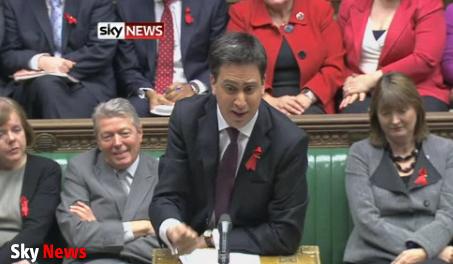
But apparently all good things have to come to an end. And so, on September 25, Ed Miliband was elected as the new leader of the Labour Party. His first performance at PMQs was awful.
Being successful at PMQs isn’t just about actually winning an argument or making a good point, it’s also about managing expectations. I truly believe watching Ed Miliband’s first outing against Cameron must have been one of the most worrying and demoralising moments of the year for Labour MPs (and it wasn’t a great year). He was predictable, slow, unoriginal, wooden, and appeared out of his depth. It was a huge let-down, and makes him the worst-performing PMQs competitor of 2010.
His performances have since improved. He is better than Brown. But he should be a lot better than Brown. He is now competing with Cameron, but he only wins when Cameron himself performs badly. Thankfully he has the potential to be better, but he will have to totally re-evaluate his approach in 2011 if he is to make the most political capital possible from what should be a very hard year for the Government. Miliband’s also still facing a Conservative leader who isn’t quite sure how to play him.
In contrast, David Cameron has had a relatively successful year at the dispatch box. His strengths are obvious: he’s quick-witted, smart, in command of his brief, and has a human demeanour. He was naturally more gifted than Brown and had learnt how to defeat him. He is better than Harman and despite her plucky performances he still regularly delivered coherent political and economic arguments.
It’s against Miliband that he’s been least impressive. Ed is not yet performing well and yet Cameron has almost let him get the better of him on a couple of occasions. He’s my top performer of 2010 but he will need to pick things up this year.
Top Performer: David Cameron
Overachiever: Harriet Harman
Underachiever: Ed Miliband
Biggest Victory: Harman absolutely destroying Clegg on tuition fees, 10 Nov.
Best Quote: Harriet Harman, 10 Nov: "We all know what it’s like: you are at freshers’ week, you meet up with a dodgy bloke and you do things that you regret. Isn’t it true he has been led astray by the Tories?"

Here's a quick and by no means comprehensive list of the things I would have considered talking about at PMQs:
The ill-advised comments of Howard Flight, which had made the Tories seem out of touch and callous. The continuing concerns about the way the NHS is being restructured. The Lib Dems were/are in disarray over whether to vote for, against or abstain over tuition fees - even Vince Cable, who is in charge of the bill, hadn't then decided what too do. There had been more protests over the fee increases. Wikileaks had just released documents suggesting the Governor of the Bank of England thought Cameron and Osborne weren't up to the job. The plan for elected Police Commissioners looks to undermine the impartiality of the police force.
So what does he ask about? The OBR report. Which said that growth this year will be better than expected and that 160,000 fewer jobs than expected will be lost through public sector cuts.
So he got torn to shreds. He questions had no direction. He didn't build momentum. Cameron couldn't believe his luck, it's hard to see how Ed Miliband could have made it any easier for him. And to top it all, he used a tired line about Thatcher which Cameron had obviously anticipated and deployed the headline-grabbing retort: 'I'd rather be a child of Thatcher than a son of Brown!'
Easy Cameron win.
The simplest way of looking at the new, developing relationship between David Cameron and Ed Miliband is to watch PMQs. Every Wednesday, the two leaders face off against each other in what is the most entertaining weekly part of our political cycle. But how exactly do you 'win' PMQs? What exactly is PMQs for? And what does the public really gain from these brief encounters? I'll be looking at these three questions separately, and in this blog post focussing on how politicians 'win' PMQs.
There are two important aspects to PMQs. The first is style. The second is substance. The most important thing to remember is that you don't have to win on both. Winning, or losing, one of them by a large enough margin will negate the other. So when Gordon Brown slipped up and said he 'saved the world', instead of 'the economy', he lost PMQs on style. It didn't matter what points of substance he raised in response to Cameron's questions. The Commons was in uproar, the debate was lost, and tomorrow's headlines had been written.
Ed Miliband's first performance was also judged on style. He managed to make Cameron seem patronising. Miliband's quip that 'despite being new to this, I'm pretty sure that I ask the questions' flooded the Labour benches with relief - that he (and, in electing him, they) wasn't going to screw up - and a belief that he could compete with and beat Cameron in the future. Yet it was also coupled with a line of questioning which had some substance - on the 'unfair' way Child Benefit is to be withdrawn from higher rate taxpayers.
David Cameron similarly joined style and substance last week when he defended the cap on Housing Benefits. It was an area which could have troubled him, but he was unequivocal in his support for the cap, saying clearly and directly that when the government is prepared to offer £20,000 a year towards rent no family should go without a home, and that to offer more would be unfair on working families that can't afford to live in those areas. He combined this policy defence with a joke about a leaked Labour document advising Ed Miliband on how to plan for PMQs: 'He's got a plan for PMQs but not for the economy.'
Winning purely on substance is rarer. In fact it is really impossible because delivery in such a charged environment will always be important and so a certain amount of style becomes a necessity. What is possible is to win on substance without landing a killer joke or getting your troops excited. But this actually comes across as a failure, because if you're winning on substance and fail on style you're missing an open goal. Without his jokes at Ed Miliband's expense, David Cameron's efforts defending the Housing Benefit cap would have ended in a draw with the Labour leader, not a victory. That this joke was a gift from Labour rather than of the Tories' own making shows how the substance of the Housing Benefit debate is yet to be won convincingly.

Over time, you would look to make your tactical victories part of a larger narrative. This is what Ed Miliband was trying to do by asking simple questions and provoking Cameron's faux indignation and condescending answers. He want's to present the PM as arrogant to the public. That's what he's doing to win on style. To win on substance over time he's seeking to hammer home his key message about the unfairness of the Coalition's spending plans. That's why he focussed on Child Benefit and Housing Benefit.
Cameron, on the other hand, is seeking to win on substance by making the most of Labour's ambiguous (at best) policy positions, and to keep reminding everyone that Labour put the country in this position. This is linked to personal attacks on Ed Miliband as both a union appointee, and as the author of Labour's election manifesto. Both could prove very damaging to Ed Miliband if they stick. These overall narratives are possibly the most important parts of the debates, because the generalised caricatures of the leaders are what filters down to the majority of the public, who are turned off by the weekly 'Punch and Judy politics' of PMQs.
Tony Blair famously remarked in A Journey that PMQs were the most nerve-racking part of being Prime Minister, and that he still gets nervous every Wednesday in anticipation. That such a capable politician and debater as Blair should say that about PMQs demonstrates how difficult they are to navigate, and how hard they are to 'win'.




 Posts
Posts

